
Most full-service property managers charge 20% to 35% of your gross booking revenue, and if you handle local operations like cleaning and maintenance yourself, that number can drop to 10% to 15%. Beyond management, you’re covering platform fees, cleaning costs, occupancy taxes, insurance, and everyday operating expenses. Together, these categories usually determine whether a property is genuinely profitable or just breaking even.
Here’s what actually shows up on an owner’s statement:
-
Management fees — the largest single line item for most owners
-
Platform/OTA fees — charged by booking sites, sometimes to you, sometimes to guests
-
Cleaning and turnover fees — per-stay costs tied to occupancy
-
Maintenance and repairs — routine and emergency
-
Occupancy and tourism taxes — set by your state or county
-
Insurance — often higher than a standard homeowner policy
-
Consumables — linens, toiletries, coffee, cleaning supplies
Quick stat: industry benchmarking puts full-service commissions at 20% to 35% of gross booking revenue, with most operators clustering in the mid-20s.
Key Takeaways
Net owner income depends far more on total fee stacking, management model, and operating cost control than on any single headline commission rate.
| Point | Details |
|---|---|
| Full-service fees run 20%–35% | Lower-cost hybrid or co-hosting models typically charge 10%–20% but require owner involvement. |
| Compare net income, not rate | A lower percentage with hidden markups can cost more than a higher, all-inclusive fee. |
| Budget for year-two cost jumps | Operating costs often run 15%–30% higher in year two due to maintenance and insurance renewals. |
| Know the 15-day IRS rule | Rentals under 15 days annually are not reportable income under IRS Topic No. 415. |
| List where travelers search | Panamacitybeachflorida helps owners reduce vacancy through direct exposure to Panama City Beach travelers. |
This article is general information, not a substitute for advice from a qualified financial advisor. Consult a qualified financial professional about your own circumstances before acting on anything here.
Table of Contents
-
What Hidden Fees and Contract Terms Should Owners Watch For?
-
List Your Property Where Panama City Beach Travelers Actually Look
What Are the Main Types of Vacation Rental Fees?
Vacation rental fees fall into two broad camps: what you pay as the owner, and what your guest pays at checkout. Understanding which is which keeps you from misreading your own statements.
Management fees cover the company or platform handling your bookings, guest communication, and often housekeeping coordination. Platform or OTA fees are charged by the booking site itself, and they show up either as a host service fee deducted from your payout or as a guest service fee added to the reservation total. Cleaning and turnover fees are typically passed through to the guest but can be marked up by a manager before you ever see the invoice. Occupancy and tourism taxes are collected from the guest and remitted to your local or state government. Payment processing fees are usually a small percentage taken off the top of every transaction.
-
Management fee → owner pays → appears on your monthly owner statement
-
Platform fee → guest or owner pays → appears on the booking confirmation
-
Cleaning fee → guest pays (often marked up) → appears on the guest invoice
-
Occupancy tax → guest pays → appears as a line item, remitted by the platform or manager
-
Payment processing fee → owner pays → deducted before payout
What Ongoing Operating Costs Should Owners Budget For?
Fees are only half the picture. The other half is the steady drip of operating costs that keep a property guest-ready, and these hit your bottom line whether you’re self-managing or paying a full-service company.
Build your budget around these recurring line items:
-
Utilities (electric, water, internet, cable)
-
Linens and laundry service
-
Cleaning labor and supplies
-
Routine maintenance (HVAC servicing, pest control, landscaping)
-
Appliance and furniture replacement
-
Property insurance (often a short-term rental policy, not standard homeowner coverage)
-
Property taxes
-
HOA or condo association dues
-
A capital reserve for unplanned repairs
Peak season drives per-booking costs up (more turnovers, more laundry, more wear) but spreads your fixed costs, like insurance and HOA dues, across more revenue. Off-season months flip that math: fewer bookings mean fixed costs eat a bigger share of each dollar earned. Costs also tend to run higher than owners expect once a property has been operating a full year. Year-two operating costs often land 15% to 30% above year-one projections, largely from maintenance issues, insurance renewals, and labor rate increases that first-year forecasts miss.
How Do Property Management Fee Structures Actually Work?
Property managers price their services in one of four ways, and the headline percentage rarely tells the full story. Comparing net income, not the advertised rate, is the only honest way to evaluate two offers side by side.
A percentage-of-booking model charges a flat cut of gross revenue, commonly 20% to 35% for full-service local management. A tiered model lowers that percentage but adds per-unit or per-booking fees on top, which can end up costing about the same or more once you total the invoice. A flat monthly fee works better for owners with consistent, predictable occupancy, since you pay the same amount whether the property is full or empty. À la carte pricing lets you pay only for specific services, like guest messaging or listing optimization, while you keep control of everything else.
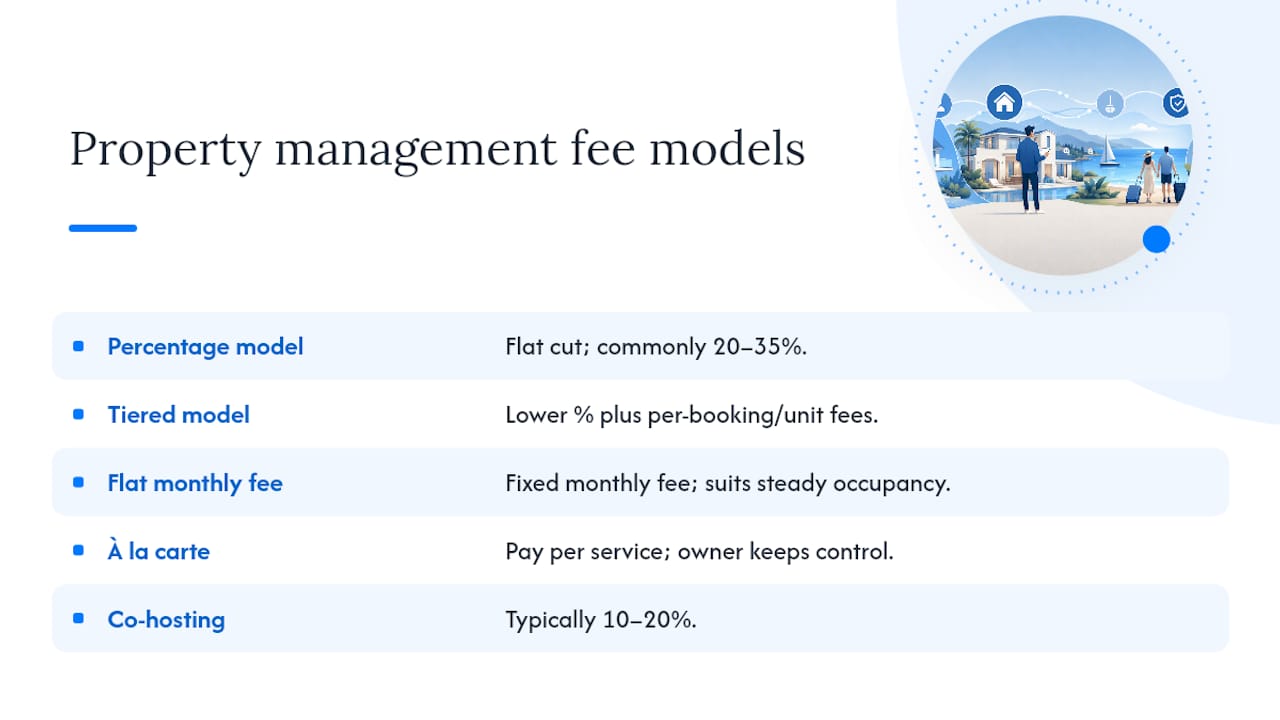
Management models also differ by who’s doing the work. Self-managing means the highest net revenue but the most personal time invested. Co-hosting arrangements, where someone handles bookings and guest communication but you still cover cleaning or maintenance, typically run 10% to 20%. Traditional full-service local managers commonly land at 25% to 35% because they’re handling marketing, distribution, 24/7 guest support, check-ins, housekeeping dispatch, and maintenance coordination as a package.
Say two identical properties each earn $60,000 in gross annual revenue. Neither number is “better” in isolation. It depends entirely on what your hours are worth.
Pro Tip: *Before signing with any manager, ask for a projected net income statement on a comparable property, not just their commission rate.
How Do Airbnb and Vrbo Fees Affect Your Payout?
Booking platforms like Airbnb and Vrbo charge fees on nearly every reservation, and the structure determines whether the cost lands on you or your guest. Full-service management platforms like Vacasa and software tools like Lodgify add another layer, either folding platform costs into their own commission or listing them separately on your monthly statement.
-
Guest books on the platform → guest service fee added to total → guest pays
-
Platform processes payment → host service fee deducted → owner’s payout reduced
-
Owner statement arrives → platform fee shown as a separate line → owner sees the net effect
Headline commission percentages are a poor way to compare management options. What actually matters is projected net income on a comparable property after every pass-through, per-unit charge, and platform fee gets factored in.
What Hidden Fees and Contract Terms Should Owners Watch For?
Some costs don’t show up until you’re already locked into an agreement. Onboarding or setup fees, professional photography charges, technology or owner-dashboard fees, and marked-up vendor invoices for repairs are the most common surprises.
Watch for these contract red flags before signing:
-
Automatic renewal clauses with long notice periods
-
Vague language around “pass-through” costs
-
Undisclosed markups on vendor or maintenance work
-
Reporting that doesn’t break down fees line by line
Before signing anything, run through this quick checklist:
-
Ask for an itemized sample owner statement from an existing client
-
Confirm the exact percentage and any minimum monthly fee
-
Request the early-termination penalty in writing
-
Verify whether cleaning fees are pass-through or marked up
How Do Fees Add Up? A Sample Profitability Calculation
Numbers make this concrete. Take a beachfront condo earning $70,000 in gross annual booking revenue.
-
Platform fee (Airbnb host fee, roughly 3%): subtract $2,100
-
Property management fee (25%): subtract $17,500
-
Cleaning costs (pass-through, guest-funded, net zero to owner in this model)
-
Operating costs (utilities, insurance, HOA, maintenance): subtract $9,000
-
Capital reserve (5% set aside for major repairs): subtract $3,500
-
Estimated net owner income: $37,900
| Line Item | Amount |
|---|---|
| Gross revenue | $70,000 |
| Platform fee (3%) | ($2,100) |
| Management fee (25%) | ($17,500) |
| Operating costs | ($9,000) |
| Capital reserve (5%) | ($3,500) |
| Net owner income | $37,900 |
Bump your cleaning fee markup or absorb even one unplanned repair, and the margin compresses further. This tracks with broader findings that cottage and vacation-property owners often retain roughly half of gross rental revenue once every expense category is factored in. Run this same math with your own gross revenue and quoted fee structure before you sign anything.

What Are the Best Ways to Reduce Vacation Rental Fees?
Lowering your costs doesn’t mean cutting corners guests will notice. It means removing inefficiency from the parts of the operation guests never see.
Start with automation. Dynamic pricing tools adjust nightly rates automatically based on demand, channel managers sync your calendar across platforms to prevent double bookings, and automated guest messaging cuts down the hours a manager (or you) spend answering the same questions. On the operational side, a preventive maintenance schedule catches small problems before they become expensive emergency repairs, bulk-purchasing linens and consumables lowers your per-turnover cost, and locking in contracts with local cleaning and maintenance vendors protects you from seasonal price spikes.
When negotiating with a manager, always ask for a projected net income statement rather than accepting the headline percentage. Request full fee transparency in writing, and where possible, push for performance-based terms tied to occupancy or revenue targets rather than a flat cut.
Pro Tip: If you’re spending fewer than 10 hours a week on your rental and it’s earning solid revenue, a hybrid or co-hosting model often beats both full self-management and full-service management on net income. Full self-management only wins once your time commitment and local knowledge make outsourcing unnecessary.
If you’d rather handle bookings yourself and cut out third-party commissions entirely, direct-booking strategies can meaningfully change your fee structure.
What Tax Rules Apply to Vacation Rental Income?
Tax treatment for short-term rentals has specific thresholds that catch owners off guard every year. Per IRS Topic No. 415, if you rent your property for fewer than 15 days during the tax year, that income isn’t reportable and you can’t deduct rental expenses.
There’s another wrinkle worth knowing: providing “substantial services,” like daily cleaning or concierge-style amenities, can shift your rental from Schedule E to Schedule C, which carries self-employment tax implications.
The line between a passive rental and an active business, for tax purposes, often comes down to material participation and the services you actually provide, not just how many nights you rent.
-
Keep detailed records of personal-use days versus rental days
-
Track every expense with receipts, separated by category
-
Note any services beyond basic housekeeping between guests
Talk to a tax professional familiar with short-term rentals before you file, since these rules shift based on your specific situation.
A Publisher’s Perspective on Owner Costs
Our focus is helping owners see real numbers, not headline rates. Panama City Beach draws millions of visitors to 27 miles of coastline every year, and the owners who do best here are the ones who understand their true costs.
List Your Property Where Panama City Beach Travelers Actually Look
Vacancy is the fee no one talks about. It doesn’t matter how competitive your management rate is if your calendar has gaps that a stronger listing strategy could have filled. Panamacitybeachflorida gives owners a direct line to travelers actively searching for Panama City Beach stays, with distribution and featured-listing placement designed to fill calendars alongside, not instead of, your existing booking channels.

That means less reliance on a single platform’s algorithm and more direct bookings, which sidesteps a layer of guest-facing platform fees entirely. Whether you’re weighing a full-service manager or considering self-management, getting your property in front of more of the right travelers is what actually moves net income. Visit the Panama City Beach vacation rentals page to list your property or see how current listings are priced and presented.
Sources
-
Average Vacation Rental Management Fees · 2026 Operator Benchmark · HostGenius
-
How much should I pay for vacation rental management? | Evolve
Recommended
-
Panama City Beach Vacation Rentals | Homes, Condos, Things To Do
-
Panama City Beach Vacation Rentals | Homes, Condos, Things To Do
About the Author
Joe Godar of the PanamaCityBeachFlorida.com Editorial Team creates destination guides, vacation-planning resources, and local travel content focused on Panama City Beach, Florida.
Our team researches local beaches, vacation rental trends, family activities, restaurants, attractions, events, and direct-booking best practices. Every guide is created to help travelers plan more confidently, experience the best of Panama City Beach, and avoid unnecessary third-party guest service fees.
PanamaCityBeachFlorida.com is part of the Emerald Coast by Owner marketing family, connecting travelers directly with verified vacation rental hosts throughout the Gulf Coast since 2016.
This article was reviewed for accuracy and updated using local destination research and current Panama City Beach vacation rental market insights.