TL;DR:
- Start with location: Decide how close you want to be to the beach, restaurants, attractions, and activities.
- Choose the right property: Compare condos, houses, beachfront rentals, pools, and other amenities based on your group.
- Check total cost: Look beyond the nightly rate to taxes, cleaning fees, deposits, and booking fees.
- Read the details: Confirm sleeping arrangements, parking, pet policies, cancellation terms, and house rules.
- Verify before booking: Review photos, location, host information, and recent guest feedback.
- Book direct when possible: Direct booking can improve host communication and help avoid third-party guest service fees.
Six things decide whether a vacation rental works for your trip: location, size and sleeping arrangements, amenities, price and total fees, reviews and host responsiveness, and cleanliness and safety. Get those six right and everything else, from check-in to how the group gets along, tends to fall into place. Get one wrong, and you’ll spend your vacation fighting a parking situation you didn’t check or splitting a bed nobody mentioned.
These criteria matter because they control three things: how comfortable your group actually is, what the stay really costs once every fee lands, and how much risk you’re carrying if something goes wrong. Here’s the shortlist to run through before you book anything:
-
Location (noise, walkability, parking, real distance to what you’re there for)
-
Size and sleeping arrangements (bed count, bed types, privacy)
-
Amenities and layout (kitchen, laundry, wifi, AC)
-
Price and total fees (nightly rate plus everything added on)
-
Reviews and host responsiveness (especially recent ones)
-
Cleanliness and safety features (alarms, locks, pool fencing)
Key Takeaways
Choosing a vacation rental comes down to verifying six criteria yourself: location, size, amenities, price, reviews, and safety, rather than trusting a listing’s marketing copy at face value.
| Point | Details |
|---|---|
| Verify the six criteria yourself | Confirm location, size, amenities, price, reviews, and safety directly rather than trusting listing copy. |
| Calculate the true total cost | Add cleaning fees, service fees, and taxes, which commonly add 30 to 45% to the nightly rate. |
| Confirm safety basics before booking | Ask about smoke and CO alarms on every level and pool fencing if a pool is present. |
| Read only recent reviews | Focus on feedback from the last 6 to 12 months to judge current management and condition. |
| Browse vetted local listings | Panama City Beach Florida’s marketplace lets you filter rentals by amenities and book directly with owners. |
Table of Contents
How Do You Choose a Vacation Rental in Under 10 Minutes?
Run this six-point check on any listing before you dig deeper. Each line maps to one of the core criteria and gives you a pass/fail threshold.
-
Price: Does the total price shown include cleaning and service fees, or just the nightly rate? Threshold: Get the all-in total before you compare anything.
-
Location: Is the pin’s neighborhood confirmed on a separate map, not just the listing’s embedded one? Threshold: match within the same block.
-
Size: Does “sleeps 6” match actual bedroom count and bed types? Threshold: ask if unclear.
-
Safety: Does the listing mention smoke and CO alarms? Threshold: no mention means you ask before booking.
-
Reviews: Are there reviews from the last 6 to 12 months, and are they good? Threshold: skip listings with zero recent activity.
-
Host response: Did a pre-book message get answered within a day?
Pro Tip: Host responsiveness before you book is the single fastest tell for how a host handles problems during your stay. A slow or vague answer to a simple question is a preview of what happens if the air conditioning fails on day two.
Which Rental Criteria Matter Most for Your Trip Type?
The same six-point checklist shifts weight depending on who’s traveling. A couple chasing a quiet weekend and a family of five need different answers to “is this the right rental?”
-
Families with kids: Prioritize safety features, a full kitchen, and an in-unit washer. Minimum threshold: at least two real bedrooms plus confirmed pool fencing if there’s a pool.
-
Couples: Prioritize location and noise level over square footage. Minimum threshold: no bars or event venues within a block.
-
Groups of friends: Prioritize bed configuration and shared spaces. Minimum threshold: confirmed sleeping arrangements for every person, not just a “sleeps 8” claim.
-
Business or remote-work trips: Prioritize wifi speed and a real desk or table. Minimum threshold: wifi rated for video calls, stated in Mbps if possible.
-
Multigenerational trips: Prioritize single-level access and proximity to medical services.
A family choosing between two nearly identical condos, for instance, should let the washer and pool gate decide, not the view.
What Should You Check About a Rental’s Location?
“Near the beach” or “steps from downtown” means very little until you verify it yourself. Cross-check the exact address on a separate map, not just the pin the listing shows you, because listing maps sometimes shift pins to a general area for privacy or marketing reasons.
Beyond distance, check these before booking:
-
Walkability to groceries, restaurants, and your main activity
-
Parking: included, paid, street-only, or nonexistent
-
Transit access if you’re not renting a car
-
Noise sources nearby: bars, live-music venues, highways, or event spaces
-
Whether the neighborhood has gated or timed access that affects late arrivals
Verifying the pin against Google Maps or Street View catches most mismatches, a step Mediahacker recommends specifically because listing addresses aren’t always exact.
Pro Tip: Ask the host directly about parking rules and gate-access timing before you book. This is the detail that trips up more travelers than bad reviews ever do, especially at properties with shared lots or entry codes that reset nightly.
Which Amenities and Layout Features Actually Matter?
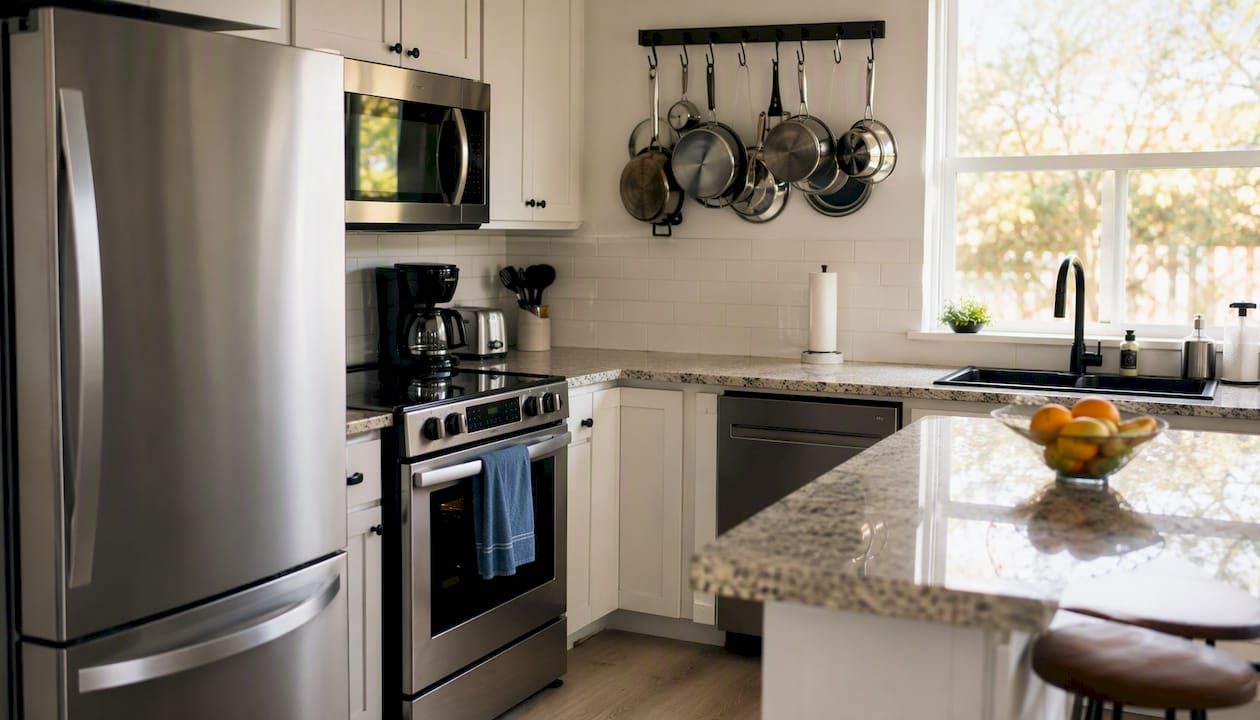
Not every amenity earns its place on your must-have list. A full kitchen, reliable wifi, in-unit laundry, dedicated parking, and working air conditioning are the ones that change your daily experience. A pool, hot tub, or premium cable package is nice, but it won’t fix a trip if the kitchen has two pots and a hot plate.
Layout matters as much as the amenity list. An open-plan studio might work fine for two adults but falls apart fast for a family of five who need doors that close at bedtime. A three-bedroom layout with a separate living area gives everyone room to decompress, which a studio simply can’t.
-
Must-have: kitchen, wifi, laundry, parking, AC
-
Nice-to-have: pool, hot tub, premium cable, outdoor grill
Pro Tip: Ask the host for current photos of the kitchen and count outlets near the beds if you’re traveling with a group that needs to charge multiple devices overnight. Listing photos often skip this detail entirely.
How Do You Read Sleeping Capacity Accurately?
“Sleeps 6” can mean six people in three real bedrooms, or it can mean two bedrooms plus a pull-out sofa and an air mattress the host forgot to mention. Bedroom count and total sleep capacity are not the same number, and listings blur that line more often than you’d expect.
Ask specifically: what are the exact bed types in each room, does any listed sleeping space rely on a sofa bed, and which rooms have doors that lock for privacy. A listing that lets couples sleep separately from kids matters more once you’re three days into a shared trip. Confirm bed configuration directly with the host, since CPSC guidance notes that “sleeps” numbers sometimes count common-area beds hosts assume you’ll use.
-
Confirm exact bed types per room
-
Ask if any beds are sofa beds or air mattresses
-
Ask which rooms have working locks
-
Request a floor plan or additional photos if the listing lacks one
How Do You Test Reviews and Host Responsiveness?
Reviews older than 12 months tell you about a property that may have changed hands, changed management, or simply aged. Focus on the last 6 to 12 months, since that window reflects who’s actually running the place now, not who ran it two years ago.
Scan reviews for recurring language, not isolated complaints. One review mentioning a noisy AC unit might be a fluke. Three reviews across different months mentioning the same issue is a pattern.
-
Search reviews for: cleanliness, noise, check-in problems, repair response time
-
Watch for repeated complaints, not single bad reviews
-
Send a pre-book question (“Does the unit have a pack-n-play available?”) and time the response
A host who answers within a few hours before you’ve even paid is a strong signal for how they’ll handle a real issue mid-stay.
How Much Does a Vacation Rental Really Cost?
The nightly rate on a listing is rarely the number you’ll actually pay. Cleaning fees, service fees, local taxes, and extra-guest charges stack on top, and together they can add real money to your total.
Cost example: A $200/night listing for 5 nights starts at $1,000. Add a $150 cleaning fee, a service fee around 12% ($120), and local occupancy tax near 10% ($100). Your real total lands closer to $1,370, not $1,000.
Fees and taxes commonly add 30 to 45% to the listed nightly rate, which is exactly why comparing listings by nightly rate alone misleads you every time.
-
Check for: cleaning fee, service fee, occupancy tax, extra-guest fees, resort or HOA fees
-
Longer stays usually lower the per-night impact of flat fees like cleaning
-
Direct booking sometimes reduces platform service fees but may trade away built-in payment protection
What Cleanliness and Safety Details Should You Confirm?
Confirm smoke and carbon monoxide alarms on every level of the property and outside every sleeping area before you book, not after you arrive. This is the minimum safety standard the CPSC recommends for any short-term rental, and it costs nothing to ask about.
Beyond alarms, check for a fire extinguisher, a basic first-aid kit, secure locks on exterior doors, and, if there’s a pool, a self-latching gate around it. Traveling with young kids raises the stakes here specifically, since open-riser staircases and unfenced pools are common hazards that rarely show up in listing photos or descriptions.
-
Smoke and CO alarms on every level, outside sleeping areas
-
Fire extinguisher and first-aid kit present
-
Secure exterior locks
-
Pool fencing with a self-latching gate, if applicable
-
Clear, stated cleaning protocol between guests
Pro Tip: Film a quick room-by-room walkthrough the moment you arrive, before you unpack anything. It takes two minutes and gives you documented proof of the property’s condition if a damage dispute comes up later over your deposit.
What Should You Confirm Before You Pay?
Two things create most post-booking regret: unclear check-in logistics and cancellation terms nobody read closely. Confirm both before you enter payment information.
For check-in, get the exact process in writing: self-check-in code, physical key exchange, or a scheduled meet-up with the host. Get a phone number you can actually reach someone at, and ask about early or late check-in fees before they surprise you at the door. If parking requires a code, gate pass, or garage ticket, get those instructions in advance too.
For cancellation, know whether the policy is flexible or strict, and read the refund windows exactly as written. A nonrefundable deposit or a holiday booking is when travel insurance earns its cost, since a strict policy paired with an unpredictable trip (weather, flights, family emergencies) is where travelers lose the most money.
-
Confirm exact check-in method and a working host contact number
-
Ask about early/late check-in fees
-
Get parking instructions in writing
-
Read the cancellation policy fully before paying
-
Consider travel insurance for nonrefundable deposits or holiday-season bookings
How Do You Spot a Fake or Risky Booking Platform Listing?
Prioritize listings with verified host badges, identity verification, and built-in payment protection, since these signals materially lower fraud risk compared to unverified postings.
Red flags to walk away from: a host asking you to pay outside the platform, photos that look inconsistent in style or lighting across the listing, an address that shifts between the map and the description, or a price dramatically below comparable listings nearby.
-
Cross-check photos against Google Street View
-
Search the property address on a second platform to confirm it exists as described
-
Ask for current photos or reasonable host identification if something feels off
How Do You Verify a Listing Is Legitimate?
Scam listings usually share a pattern: a price that’s too good, pressure to move fast, and a request to pay somewhere other than the platform. Legitimate hosts rarely mind a few extra questions before you book, and they rarely need you to wire money to a personal account.
Start with the address. Search it independently, not just through the listing’s map pin, and see if the same property shows up on other rental sites with matching photos and pricing. A property that only exists on one obscure site, with no other digital footprint, deserves extra scrutiny.
Check for verified badges or host identity confirmation on the platform itself. Booking platforms that verify hosts and back reservations with payment protection cut your exposure significantly compared to a listing with no verification at all. If a host asks you to complete payment through a personal payment app or a wire transfer instead of the platform’s checkout, that’s the clearest scam signal there is. Legitimate hosts get paid through the platform because that’s how disputes get resolved if something goes wrong.
Reverse image search a few of the listing’s main photos. If the same images appear attached to a different address or a different host name somewhere else online, that listing is not what it claims to be. Combine that with a quick read of recent reviews. A brand-new listing with a suspiciously high volume of five-star reviews posted within days of each other is a pattern worth avoiding. Real review histories build up slowly and unevenly, not all at once.
Running through budget, exact location, reviews, and photo verification as a fixed pre-book routine catches the vast majority of problem listings before money changes hands.
What Rental Laws and Regulations Should You Know About?
Vacation rental regulations vary heavily by city and county, and they change often enough that a listing that was legal last year might not be this year. Some destinations cap the number of nights a property can be rented short-term, require the host to hold a specific permit, or restrict short-term rentals to certain zoning districts entirely.
This matters to you as a guest for a practical reason: if a property is operating without the required local permit, a stay can be canceled abruptly, sometimes with little notice, if local enforcement catches up with the host. It’s rare, but it happens most often in destinations that have recently tightened short-term rental rules.
You won’t always see permit numbers listed, and that’s not automatically a red flag since requirements differ by location. But if a listing description mentions a registration or license number, that’s a good sign the host is operating within local rules. If you’re renting somewhere with a history of strict short-term rental enforcement, a quick search for “[city name] short-term rental rules” before booking takes a few minutes and can save you a canceled trip.
Homeowner association rules add another layer in condo buildings and gated communities. Some HOAs cap guest counts, restrict pool hours, or charge separate guest fees that show up only after you’ve booked. Ask the host directly whether the property sits inside an HOA with rental restrictions, especially if you’re traveling with a larger group or planning to bring a pet.
How Do You Compare Multiple Rental Listings Effectively?
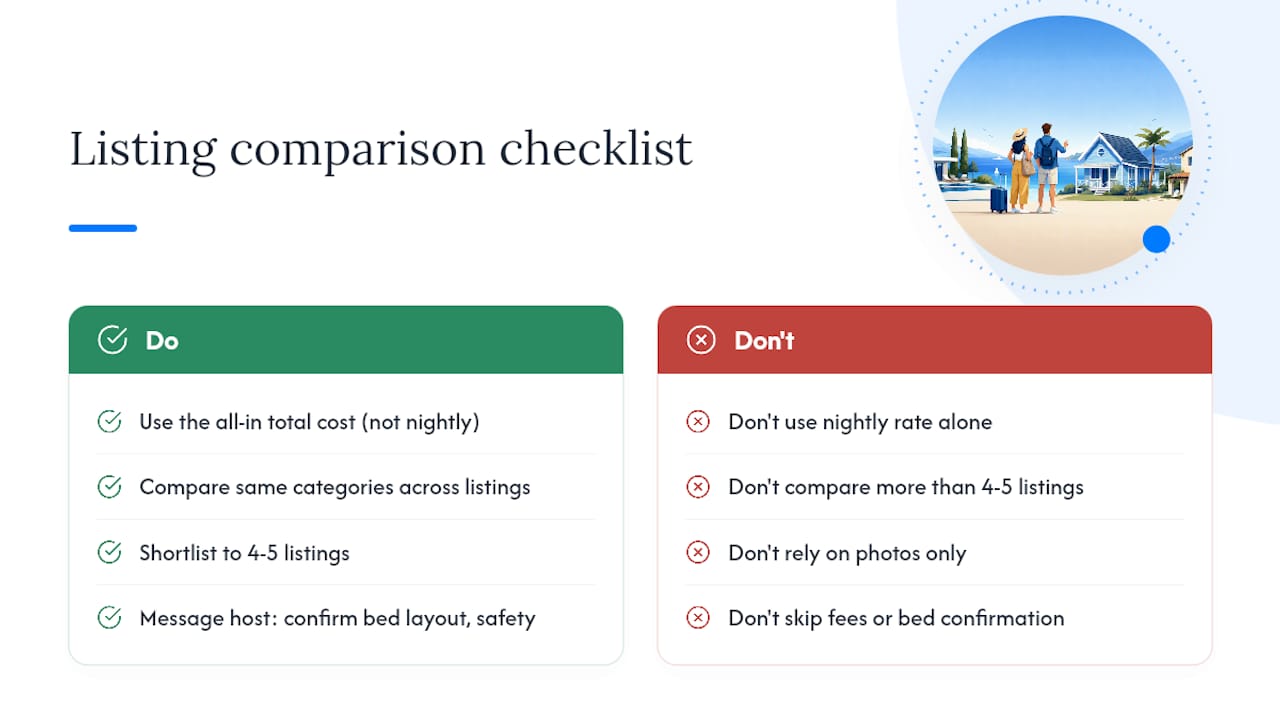
Comparing listings side by side only works if you’re comparing the same numbers. Pull the all-in total cost, not the nightly rate, for every listing you’re seriously considering, since fees vary enough between properties to flip which one is actually cheaper.
Build a simple side-by-side list with the same categories for each property: total price for your dates, bedroom and bed count, distance to your main activity, most recent review date, and confirmed safety features. Seeing these lined up next to each other makes weak spots obvious fast. A listing that looks perfect on price alone often loses that advantage once you add its cleaning fee and confirm it’s a 20-minute drive from where you actually want to be.
Don’t compare more than four or five listings at once. Past that number, details blur together and you’ll end up rebooking based on which photo you remember best rather than which property actually fits your criteria. Shortlist early, then go deep on the finalists: message the host, ask about bed configuration, and confirm safety features before you rank them.
Pay attention to how each listing’s price and amenities scale for your exact group size and dates, since a property that’s a bargain for two adults in the off-season might turn into the most expensive option once you add kids and peak-season pricing. If you’re deciding among several beachfront condos or family homes in the same area, filtering by your locked amenities first (kitchen, laundry, bedroom count) narrows the field before price ever enters the comparison.
Should You Book Through a Platform or Directly With an Owner?
Booking through an established platform gives you built-in payment protection, a dispute-resolution process, and a paper trail if something goes wrong. That protection is worth something, particularly for a family paying a significant deposit on a property they’ve never seen in person.
Direct booking with a property owner can lower your total cost by cutting out platform service fees, and it sometimes gives you more flexibility on cancellation terms since you’re negotiating directly rather than working within fixed platform rules. The trade-off is that you’re relying entirely on the owner’s word if a dispute comes up, with no third party backing the transaction.
A reasonable middle ground: use a platform or a vetted local marketplace to find and vet the property, then ask the host directly about flexibility on dates, pricing, or extras once you’ve built some trust through a few messages. Many hosts are willing to work with returning guests or longer stays outside the platform’s standard terms, without giving up the protection of booking through it the first time. A marketplace built specifically around one destination, rather than a global platform listing millions of unrelated properties, also tends to surface listings with more locally relevant detail about parking, HOA rules, and neighborhood noise.
How Do You Know If Listing Photos Are Accurate?
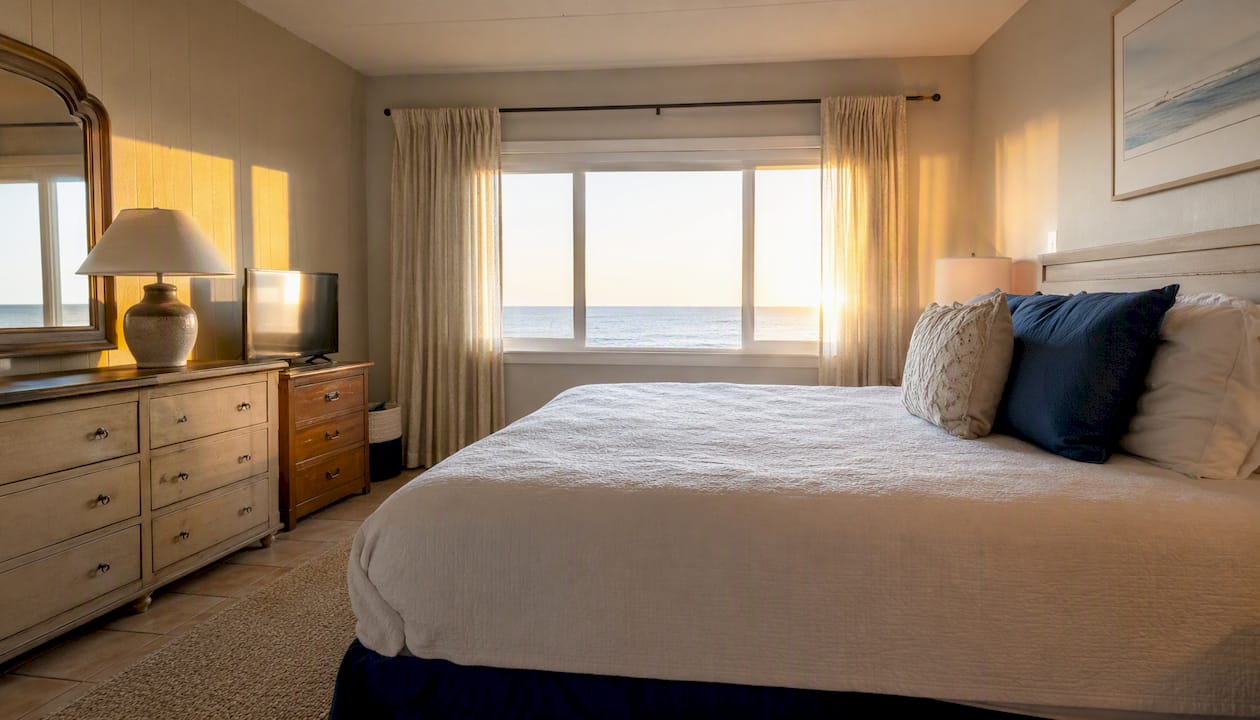
Wide-angle lenses make small rooms look spacious, and good lighting can hide worn furniture or dated finishes. Neither is necessarily deceptive, but both mean you should read photos with a slightly skeptical eye rather than taking them at face value.
Check the photo count and variety first. A listing with only five or six photos, all shot from flattering angles with no close-ups of the kitchen, bathroom, or bedrooms, tells you less than a listing with 20 or more photos covering every room and angle. Ask for additional photos of anything that matters to you specifically, like outlet placement near the beds or the actual size of the shower.
Compare the exterior photos against Street View if the address is available. A mismatch between the building shown in listing photos and what actually sits at that address is one of the clearest signs something is wrong with the listing. Good listing photography genuinely helps a property book faster, but it should represent the space honestly, not misrepresent its size or condition.
Finally, check photo dates if the platform shows them, or ask the host how recent the photos are. A property renovated two years ago with photos from before the renovation, or one that’s aged since the photos were taken, can leave you walking into something noticeably different from what you booked.
A Note on Why This Checklist Is Ordered This Way
Safety and layout come first here because they’re the items travelers regret skipping most, especially families traveling with young kids where a missing pool gate or an unclear bedroom count causes real problems on day one. Fees and location come next because they’re where budget travelers get burned by a rental that looked cheap until the total landed.
The order isn’t arbitrary. It follows the sequence of what actually breaks a trip, starting with safety and ending with the smaller comfort details that matter but rarely ruin anything.
Ready to Browse Vetted Panama City Beach Rentals?
Panama City Beach Florida is where this checklist becomes useful in practice rather than theory. Every property on our vetted rental marketplace is filterable by exactly the criteria this guide walks through: bedroom count, pool access, distance to the beach, and direct contact with the owner or manager listing it.
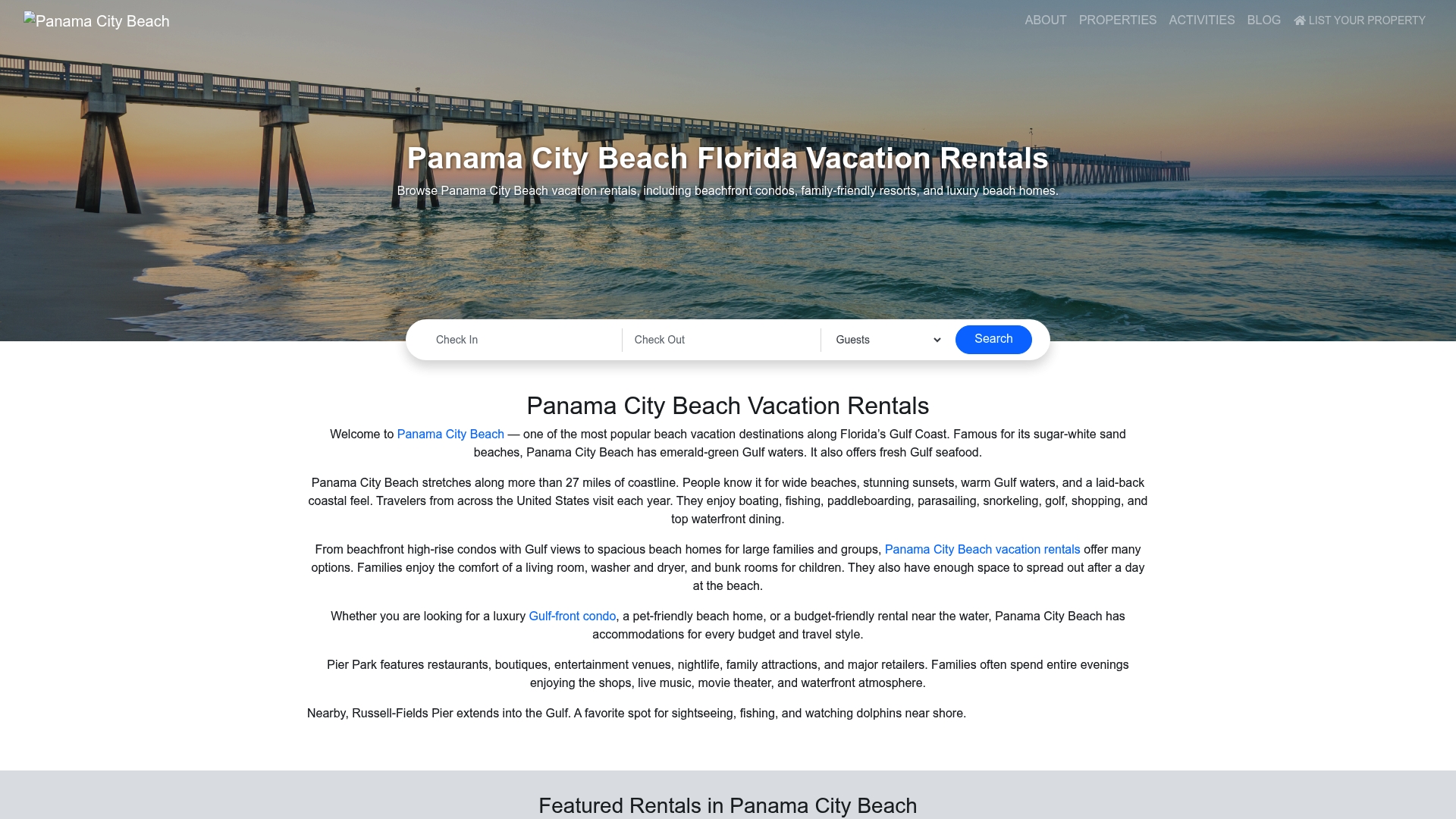
That last point matters more than it sounds. Booking direct with a local owner through our marketplace means you can ask about parking, pool fencing, or bed configuration before you pay, the same pre-book questions this guide recommends, without waiting on a support ticket from a platform that’s never seen the property. Whether you’re weighing a beachfront condo against a family home a few blocks back from the sand, our listings cover both, with real photos and current availability for Panama City Beach’s more than 27 miles of coastline. Start browsing available Panama City Beach vacation rentals and filter by your must-have amenities to find a property that matches your checklist, not just your budget.
Sources
-
Vacation Rental Trip with Kids: 9-Step Guide (2026) — Endless Travel Plans
-
The Ultimate Checklist Before Booking Your Holiday Rental — Oversea Rentals
Recommended
- Best Vacation Rental Sites for Beach Trips in 2026
- Vacation Rentals with Private Pool in Panama City Beach
- Splash Beach Resort Panama City Beach Vacation Rentals
- Top 5 Budget-Friendly Airbnb Alternatives 2026
About the Author
Joe Godar of the PanamaCityBeachFlorida.com Editorial Team creates destination guides, vacation-planning resources, and local travel content focused on Panama City Beach, Florida.
Our team researches local beaches, vacation rental trends, family activities, restaurants, attractions, events, and direct-booking best practices. Every guide is created to help travelers plan more confidently, experience the best of Panama City Beach, and avoid unnecessary third-party guest service fees.
PanamaCityBeachFlorida.com is part of the Emerald Coast by Owner marketing family, connecting travelers directly with verified vacation rental hosts throughout the Gulf Coast since 2016.
This article was reviewed for accuracy and updated using l